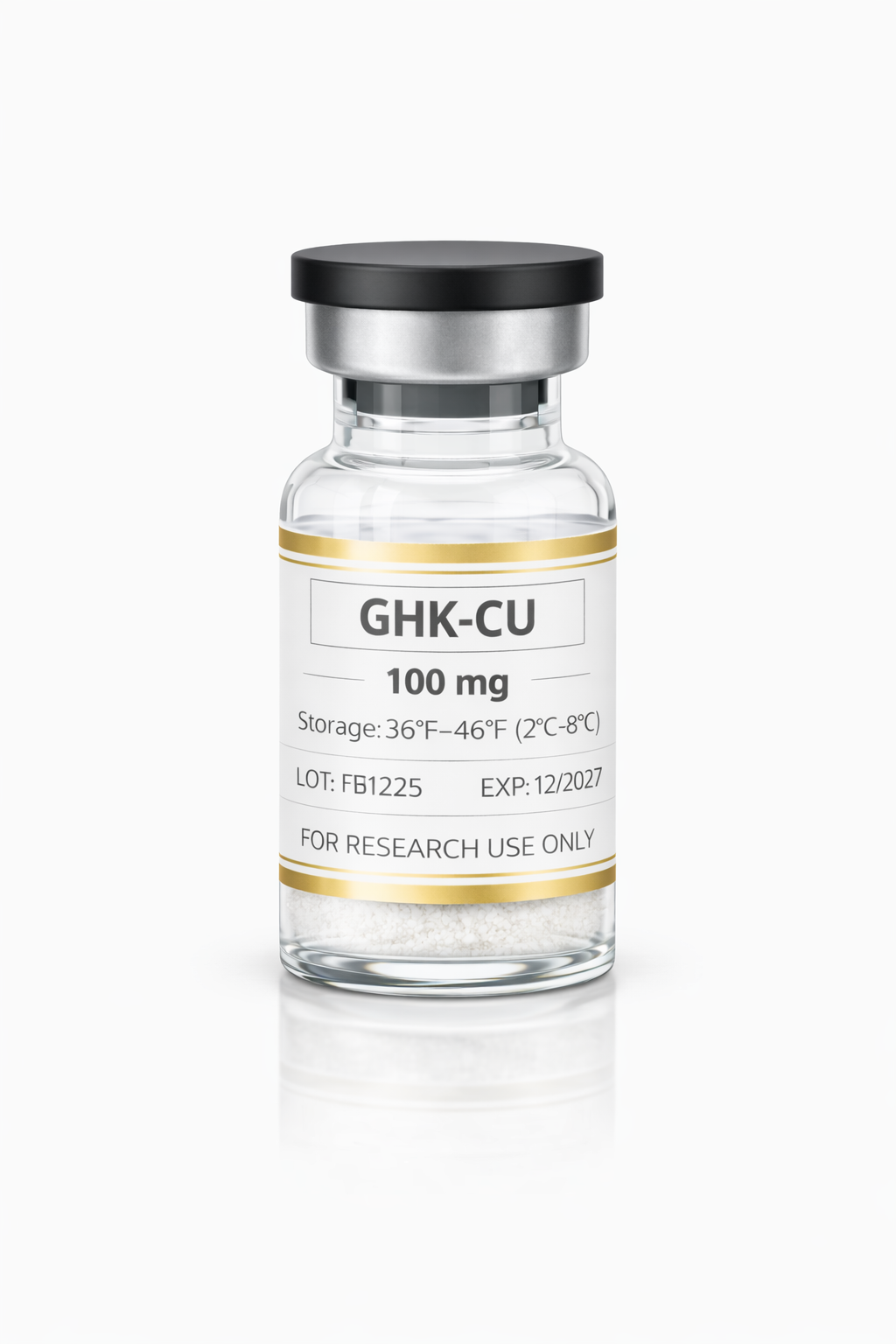
GHK-CU 100MG
GHK-CU (Glycyl-L-Histidyl-L-Lysine Citrate) is a peptide compound derived from human plasma proteins, widely studied in academic and industrial research settings for its potential cellular interactions and biological effects. This product is provided exclusively for laboratory use in accordance with ethical and regulatory standards governing peptide research.
GHK-CU has emerged as a subject of extensive scientific inquiry due to its role in cellular repair processes, particularly in studies investigating skin wound healing, inflammation modulation, and cellular senescence. Its structure, composed of three amino acids, facilitates membrane penetration, enabling intracellular delivery of bioactive signals.
Research Context
GHK-CU was first isolated from human serum and identified as a key component of the extracellular matrix (ECM). Over the past several decades, research has explored its mechanisms at the molecular level, including interactions with integrins, nuclear factor kappa-light-chain-enhancer of activated B cells (NF-κB), and other signaling pathways. Early studies in animal models demonstrated enhanced wound healing, reduced fibrosis, and attenuated oxidative stress.
Research Overview
GHK-CU is typically synthesized via solid-phase peptide synthesis (SPPS) to ensure purity and consistent composition. Its research applications span fields such as dermatology, toxicology, and tissue engineering. In vitro studies often employ cell lines (e.g., keratinocytes, fibroblasts) to investigate its effects on cytoskeletal dynamics, extracellular matrix deposition, and apoptotic pathways. In vivo research frequently utilizes small animal models (e.g., mice, rats) to assess systemic distribution, pharmacokinetic properties, and therapeutic efficacy in disease models.
Key Research Focus Areas
- Cellular Uptake and Intracellular Signaling: GHK-CU’s ability to traverse cell membranes and modulate signaling cascades, including those involving matrix metalloproteinases (MMPs) and transforming growth factor-beta (TGF-β).
- Wound Healing and Tissue Repair: Mechanistic studies examining its role in epithelialization, granulation tissue formation, and scar reduction via modulation of inflammatory responses.
- Inflammation and Immunoregulation: Exploration of GHK-CU’s potential to suppress pro-inflammatory cytokines (e.g., TNF-α, IL-6) and promote anti-inflammatory mediators (e.g., IL-10) in preclinical models.
- Neuroprotection and Neurodegeneration: Emerging research into its effects on neuronal survival, mitochondrial function, and synaptic plasticity in models of neurodegenerative diseases.
- Pharmacokinetics and Safety Profiling: Analysis of GHK-CU’s biodistribution, clearance kinetics, and tolerability in animal studies, including comparisons to endogenous peptide pools.
This product is provided in a lyophilized form for reconstitution with sterile aqueous solutions, ensuring sterility and stability for laboratory use. Research laboratories are advised to follow established protocols for handling peptides, including proper aseptic technique, contamination control, and disposal procedures.
For research use only. Not for human or animal consumption.
Reviews
There are no reviews yet.